
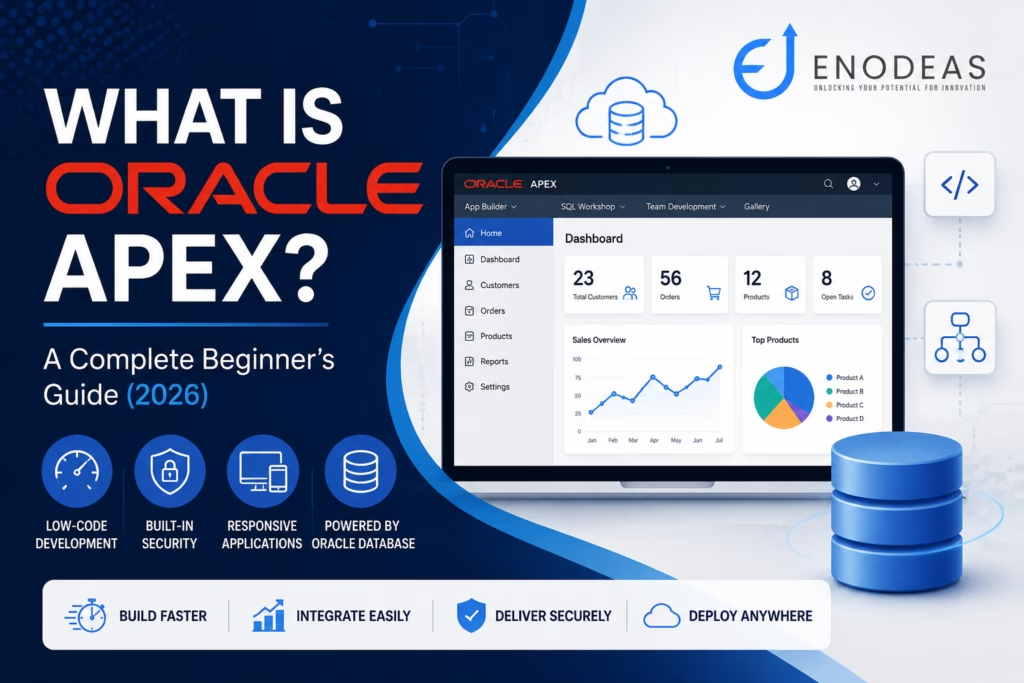
What is Oracle APEX?
Oracle Application Express, commonly known as Oracle APEX, is a low-code web application development platform that runs entirely within the Oracle Database.
Unlike traditional development frameworks where you need separate application servers and multiple programming languages, APEX enables you to design, develop, and deploy applications using a web browser.
The platform is built around declarative development. Instead of manually coding every screen, report, and form, developers configure components using intuitive wizards and property editors. Whenever custom business logic is required, SQL and PL/SQL can be seamlessly integrated.
Because APEX runs inside the Oracle Database, applications benefit from the database’s performance, scalability, and enterprise-grade security.
Table of Contents
Why Should You Learn Oracle APEX?
APEX has become one of the fastest-growing Oracle technologies because it combines rapid application development with the reliability of the DBMS.
Here are a few reasons why organizations are increasingly adopting APEX:
- Develop applications significantly faster than traditional frameworks.
- Reduce development and maintenance costs.
- Build responsive applications without extensive front-end development.
- Leverage existing Oracle Database investments.
- Integrate easily with Oracle E-Business Suite, Oracle Cloud, and third-party applications.
- Deliver secure enterprise applications using built-in security features.
For Oracle developers already familiar with SQL and PL/SQL, learning Oracle APEX is a natural progression that opens the door to modern web application development.
Key Features of Oracle APEX
Oracle APEX provides a rich set of features that simplify application development while maintaining enterprise-level capabilities.
Low-Code Development
APEX minimizes repetitive coding through declarative development. You can create forms, reports, dashboards, and interactive pages within minutes using built-in components.
Developers still have complete control to customize applications using SQL, PL/SQL, JavaScript, HTML, and CSS whenever needed.
Browser-Based Development
Everything is developed using a web browser. There is no need to install a separate integrated development environment (IDE).
You can design, test, and deploy applications directly from the Oracle APEX workspace.
Responsive User Interface
Applications created with Oracle APEX automatically adapt to desktops, tablets, and mobile devices.
This eliminates the need to develop separate mobile applications for most business scenarios.
Enterprise Security
Security is built into the framework from the beginning.
Oracle APEX provides:
- Authentication
- Authorization
- Session Management
- Protection against SQL Injection
- Cross-Site Scripting (XSS) protection
- Cross-Site Request Forgery (CSRF) protection
These features help developers build secure applications without implementing complex security mechanisms manually.
Tight Oracle Database Integration
APEX works directly with Oracle Database objects such as:
- Tables
- Views
- Packages
- Procedures
- Functions
- Sequences
- Materialized Views
This close integration simplifies application development and improves overall performance.
How Does Oracle APEX Work?
APEX follows a straightforward request-processing architecture.
- A user accesses an Oracle APEX application through a web browser.
- Oracle REST Data Services (ORDS) receives the request.
- ORDS forwards the request to the Oracle Database.
- The APEX engine processes the page.
- SQL and PL/SQL execute the required business logic.
- The generated page is returned to the user’s browser.
Since the Oracle Database handles both data storage and application processing, there is no need for a separate application layer in many deployments.
In the next article of this learning roadmap, we’ll explore this architecture in greater detail.
Where is Oracle APEX Used?
APEX is used across industries to build a wide variety of business applications.
Some common examples include:
- Employee self-service portals
- Procurement applications
- Customer relationship management (CRM) systems
- Inventory management applications
- Leave management systems
- Vendor portals
- Dashboard and analytics solutions
- Approval workflows
- Project management applications
- Internal business applications
Organizations often choose Oracle APEX to modernize legacy Oracle Forms applications and extend existing Oracle ERP systems.
APEX and Oracle EBS
One of Oracle APEX’s biggest advantages is its ability to complement Oracle E-Business Suite without modifying standard Oracle code.
Many organizations use APEX to build modern interfaces for existing EBS processes.
Common integration scenarios include:
- Procurement approval portals
- Supplier self-service applications
- Inventory dashboards
- Customer management applications
- Concurrent program execution
- REST API integration
- Workflow automation
- Executive dashboards
Throughout this learning series, we’ll demonstrate practical APEX and EBS integration examples based on real-world implementation experience.
Who Should Learn Oracle APEX?
APEX is suitable for professionals from different technical backgrounds.
It is particularly valuable for:
- Oracle Database Developers
- SQL and PL/SQL Developers
- Oracle EBS Technical Consultants
- Oracle Forms Developers
- Database Administrators (DBAs)
- Oracle Cloud Developers
- Technical Architects
- Students interested in Oracle technologies
If you already have a good understanding of SQL and PL/SQL, you’ll find APEX relatively easy to learn.
Conclusion
Oracle APEX has transformed the way Oracle professionals build web applications. By combining the power of the Oracle Database with a low-code development approach, it enables developers to deliver secure, responsive, and enterprise-grade applications in a fraction of the time required by traditional development methods.
Whether you’re extending EBS, creating internal business applications, or beginning your low-code development journey, Oracle APEX provides a powerful platform to turn ideas into production-ready solutions.
This article is the first step in our Oracle APEX Learning Roadmap.
Next Article: APEX Architecture Overview – Understand how ORDS, the Oracle Database, and the APEX Engine work together to process every application request.
Frequently Asked Questions
Is Oracle APEX free?
Yes. APEX is included at no additional cost with Database. Hosting and database licensing costs may apply depending on your deployment model. You can create a free User account for development.
Do I need Java to learn Oracle APEX?
No. Most APEX applications can be developed using SQL, PL/SQL, and the declarative development environment. JavaScript is only required for advanced customizations.
Can Oracle APEX integrate with EBS?
Absolutely. APEX can integrate with EBS using REST APIs, PL/SQL packages, public APIs, database links, and Oracle Integration Cloud.
Is APEX suitable for enterprise applications?
Yes. APEX is widely used to build secure, scalable, and mission-critical enterprise applications across various industries.

Pingback: App Builder and SQL Workshop in Oracle APEX: Ultimate Guide
Pingback: Oracle APEX Workspace Setup: Step-by-Step Beginner Guide
Pingback: Oracle APEX Architecture: A Complete Guide